Building an e-commerce site for an artisan brand is not about stacking product pages. It means solving three problems regular shops never face: a catalogue of one-off pieces, a product page that replaces in-workshop advice, and payments built around mobile money.
The 4 key decisions behind the Graine de Lumière project:
- A dual-entry catalogue: by collection and by stone
- Complete product pages: worn photos, dimensions, intended benefit, visible price
- An editorial layer (stone pages, guides, blog) that keeps pulling traffic
- Mobile-first payments, with bank cards as a secondary option
⏱️ 6 min read · Real client case, live website
Building an e-commerce site for an artisan brand calls for a different architecture than a standard online shop: your stock is made of one-off pieces, not endlessly reorderable references. The catalogue, the product page and the checkout path all have to be rethought around that constraint.
Many makers stop at Instagram and handle sales through direct messages. The result: no traffic of their own, no customer data, and a visibility that collapses the day the algorithm shifts.
Here is the method applied to the Graine de Lumière website, a brand of handmade natural stone jewellery and candles, and what you can reuse from it.
01Why does an artisan brand not sell like a regular shop?
Because your product carries a story, and that story is part of the price.
A labradorite necklace at 60,000 FCFA does not sell on its spec sheet. It sells on intention, on where the stone comes from, on the maker's hand, and on the meaning the buyer attaches to it.
Three structural differences to build in from the start:
🎯 Stock is limited, sometimes to a single piece. Your site has to handle unavailability without looking abandoned.
🎯 The buying decision is emotional before it is rational. Content weighs more than any price comparison.
🎯 The brand and the product are inseparable. The founder is part of the sales argument.
Before talking about a shop at all, check that e-commerce is even the right format. Some craft businesses sell better with a showcase site plus order taking over WhatsApp. That call is made upfront, as our comparison of website types for a professional activity explains.
02Where do you start before touching the design?
With a real inventory of what you sell, and with the words your customers actually use.
On the Graine de Lumière project, the groundwork covered three points before any mockup:
1. Mapping the catalogue
How many product families? Jewellery, candles, dreamcatchers. Each one has its own photo, stock and shipping constraints.
2. The customers' vocabulary
Buyers do not search for "handmade necklace". They search for "amethyst sleep", "protection stone", "rose quartz self-love". That vocabulary then shapes the whole site structure.
3. The level of autonomy wanted
A maker adding two pieces a week needs a simple back office, not a machine she has to fight. This is always scoped by our website creation agency before production starts.
⚠️ A badly scoped e-commerce site costs twice: once to build, once to rebuild.
03How do you organise a catalogue when every piece is unique?
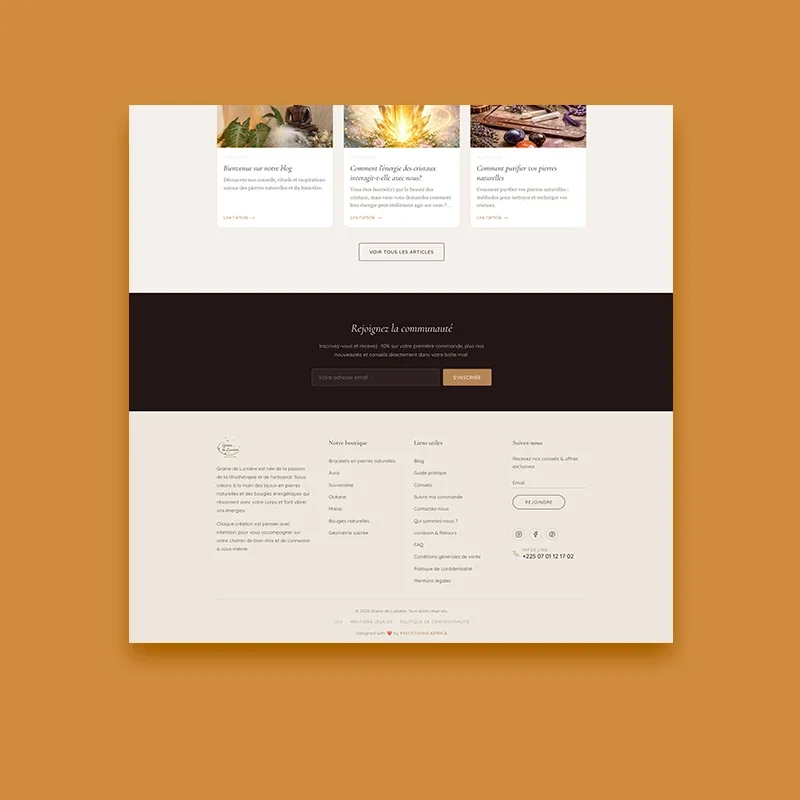
By creating two parallel entry points: one by collection, one by material.
This was the structuring decision of the project. A single hierarchy would have locked the brand into a flat catalogue, hard to grow.
|
Entry point |
What it groups |
Which need it answers |
|
Collections |
Aura, Souveraine, Océane, Malas, Attrape-soleil |
The buyer who wants a look, a mood |
|
Stones |
Amethyst, labradorite, rose quartz, lapis lazuli, tiger's eye, turquoise |
The buyer looking for a specific benefit |
|
New arrivals |
The latest pieces published |
The returning customer checking what's new |
|
Limited editions |
Pieces that will not be remade |
The buyer who values rarity |
The benefit is twofold. On the customer side, two natural paths to purchase. On the SEO side, stone pages become durable landing pages that stay relevant even as the pieces change.
✅ A sold piece leaves the cart, the stone page stays and keeps bringing in traffic.
Ready to actually sell online?
Online store, showcase site or redesign: we build websites made to convert, not just to look good.
Request a free quoteReply within 24 business hours · No-commitment quote
04What makes an artisan product page convert?
It has to replace what the customer loses by not standing in your workshop: touch, light, and above all your advice.
An artisan product page that converts includes:
✅ Multi-angle photos in real conditions, worn if it is jewellery, lit if it is a candle
✅ Exact dimensions and materials, stone by stone
✅ The intended benefit, written in the customer's words: calm, grounding, confidence
✅ A clear note when the piece is one of a kind
✅ The price shown plainly, here between 38,000 and 60,000 FCFA depending on the piece
✅ A link to the stone's own page, so the buyer can dig deeper without leaving the funnel
❌ What to avoid: 400 words of poetry with no concrete information. Emotion sells, vagueness drives people away.
05How does content turn an artisan site into a traffic engine?
By answering the questions buyers ask before they buy, not after.
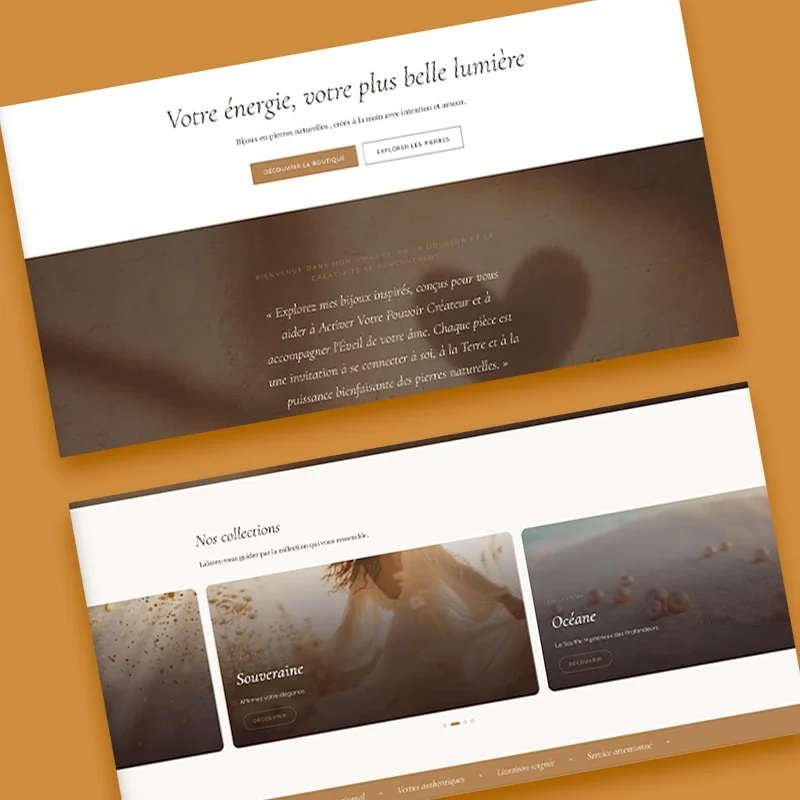
This is the most profitable layer of an artisan e-commerce site, and the most neglected. On Graine de Lumière it rests on three blocks:
Stone pages. Every stone has its page, with its properties and the chakra it relates to. These are evergreen, indexable pages that capture precise searches.
Practical guides. How to choose your stone, how to cleanse it. This content answers a real objection before purchase.
The blog. It keeps the brand editorially fresh and creates natural opportunities to link back to product pages.
The logic holds in any sector: content attracts, the product page converts. It is exactly what we apply on our SEO projects in Abidjan, whether the client sells jewellery or industrial equipment.
06Which payment methods should you plan for in West Africa?
Mobile money first, bank cards second.
This is the most expensive mistake made by e-commerce sites copied from European models. According to the World Bank's Global Findex 2025, 40% of adults in sub-Saharan Africa had a mobile money account in 2024, and 58% held a financial account, up from 49% in 2021. In Senegal and Benin, mobile money alone accounts for more than 70% of e-commerce transactions.
A site that only accepts cards rules out most of its potential buyers before they ever reach the cart.
📍 The reflexes to apply:
-
Integrate the operators that genuinely dominate your market, not all four at once
-
Offer an assisted WhatsApp ordering route for first-time buyers
-
Show delivery times and zones on the product page, not only in the terms and conditions
For the detail of the gateways available locally, our guide on setting up an online store in Côte d'Ivoire covers the technical and regulatory side.
07Recap: the 6 stages of the project
|
Stage |
Concrete deliverable |
Watch out for |
|
1. Scoping |
Product inventory, customer vocabulary, autonomy level |
Do not start the design before this |
|
2. Architecture |
Dual entry by collection and material |
Plan for catalogue growth |
|
3. Design and identity |
A visual world true to the brand |
Aesthetics serve readability, not the reverse |
|
4. Product pages |
Photos, dimensions, benefits, price |
An incomplete page cannot be salvaged later |
|
5. Payment and delivery |
Mobile money first, delivery times shown |
Test the whole path on a phone |
|
6. Content and SEO |
Evergreen pages, blog, internal linking |
This one never really ends |
08In short
A successful artisan e-commerce site rests on four foundations:
✅ A dual-entry catalogue built for one-off pieces
✅ Product pages that replace in-store advice
✅ Payments matched to local habits
✅ An editorial layer that keeps pulling traffic
The Graine de Lumière website shows that an artisan brand can run an e-commerce operation as solid as any established retailer, without losing its soul.
09FAQ
How many products do you need to launch an artisan online store?
Around fifteen well-photographed references are enough. An empty catalogue looks abandoned, a huge and poorly documented one discourages buyers. Fewer pieces, perfectly presented, works better.
Do you still need a website if you already sell on Instagram?
Yes, for three reasons: you build an asset you actually own, you collect usable customer data, and you show up in Google searches. Instagram is an acquisition channel, not a durable point of sale.
How do you handle one-off pieces once they are sold?
Two complementary options: remove the piece from the active catalogue and keep its page as a gallery item, or offer a custom order request. Either way, never let a buy button lead to an error page.
Which platform should an artisan brand choose?
It depends on your volume, the autonomy you need and your local payment methods. The right choice comes after scoping, never before. A platform picked upfront almost always ends up constraining the brand.